
Recently, within the framework of the Farmer Support Program of the All-Ukrainian Congress of Farmers in partnership with the international organization Mercy Corps, a webinar “What awaits a farmer upon joining the EU” was held. The event was aimed at supporting Ukrainian agrarians. Mykola Moroz, Deputy Director of the Department – Head of the Rural Development Department of the Ministry of Economy, Environment and Agriculture, spoke about all the nuances and requirements for farmers in the EU.
Mr. Mykola, please tell us in more detail what the essence of the Common Agricultural Policy is and what we can expect when joining the EU? What benefits does it offer for farmers, and for Ukrainian farmers in particular?
— The European Union has many different countries with specific conditions. The agricultural needs of Northern European countries differ significantly from those of Southern European countries. Each has its own interests; each country wants to provide maximum benefits for its farmers, and this is normal.
In essence, to avoid internal conflicts and misunderstandings, the EU has developed an instrument called the Common Agricultural Policy (CAP), which defines the rules for what happens, how it happens, how rural areas develop, and how it affects the protection of natural resources.
Regarding the benefits, the first, and perhaps what everyone talks about, is access to financing. If you meet certain conditions, you are guaranteed stable payments, and in principle, this allows you, as producers, to plan your activities for several years ahead.
Mykola Moroz, Deputy Director of the Department – Head of the Rural Development Department of the Ministry of Economy, Environment and Agriculture Next is the issue of rural development. The European Union views agricultural development not solely as a business. It views it in conjunction with social and environmental issues. Therefore, as we integrate more closely with the European Union, the issue of rural development will become increasingly relevant.
Next is access to innovation. Europe has a comprehensive and extensive system for knowledge and innovation transfer, which is already being implemented in Ukraine, perhaps you have heard of it. Recently, the AKIS digital platform was presented in Ukraine. This system also operates in Europe. They have a similar electronic platform called EU-FarmBook, where farmers can learn about the latest news and the newest technologies in the field. And we are also implementing this system in Ukraine.
Equally important is a stable market. This is a set of measures in the European Union aimed at curbing sharp price fluctuations. It also includes mechanisms for protection against crises: in case of unforeseen circumstances, special programs are in place that allow for quick responses to challenges and support for farmers. This is logical, as agriculture is a high-risk production where weather and market conditions significantly impact the outcome.
Agro-environmental practices are a condition for receiving subsidies, and farmers who implement advanced agro-environmental practices can qualify for increased payments. And perhaps one of the main goals is the preservation of villages. This is what the European Union talks about, and what we will certainly implement in Ukraine.
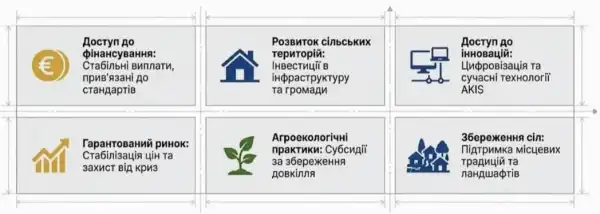
Common Agricultural Policy and Benefits for Farmers
What financial support mechanisms exist for Ukraine in the agricultural sector until it joins the EU?
— The European Union’s planning is done in seven-year periods. Until 2027, the Common Agricultural Policy provides almost 390 billion for farmer support. This is a significant sum. It is understood that during this period, we cannot claim these funds.
That is, if we are talking about any support from the European Union, it will be no earlier than 2028, and I want to emphasize this, because it is very, very important. We have two paths.
The first path is the traditional one, used by EU member states. This is the pre-accession support program. In this budget period, it is called IPA. Ukraine gains access to the financial support program for candidates — Instrument for Pre-accession Assistance (IPA). And, in principle, each country receives a certain budget that it can allocate for pre-defined needs.
The second option may seem a bit fantastic, but nevertheless, I must mention it — direct access to EU funds as a member state of the European Union. I will say upfront that it is unlikely, but nevertheless, it is being discussed, so I must mention it.
Currently, the Common Agricultural Policy is divided into two very large funds. The first fund is the European Agricultural Guarantee Fund. Direct farmer support.
What does direct farmer support mean?
— Direct support means that a farmer unconditionally receives support per hectare or per head of livestock, regardless of what they grow. This is the minimum support threshold that every farmer receives. I will say right away that each state sets an upper limit for such support. Why? Because the European Union believes, and rightly so, that large farms should not receive such support.
In essence, the EU has a complex mechanism where, as the area increases, the amount of support decreases, up to its complete cessation. That is, the priority is for small and medium-sized farmers; large farmers have a number of limitations and, as a rule, either do not receive such support or receive it in small, limited amounts.
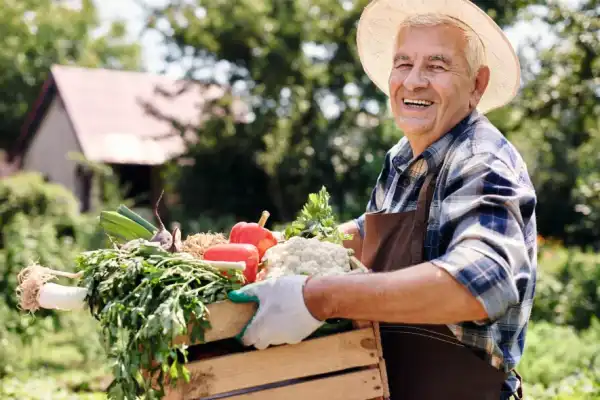
Direct support means that a farmer unconditionally receives support per hectare or per head of livestock, regardless of what they grow The second fund is the European Agricultural Fund for Rural Development (EAFRD), which involves co-financing projects. In essence, one of the approaches implemented within this financing is the LEADER initiative, which supports local development projects through a co-financing mechanism.
LEADER involves the creation of local initiative groups with the participation of authorities, businesses, and active citizens who develop and implement ideas for their territory’s development, financing various projects — from energy independence to the processing of agricultural products and the development of the local economy.
Please tell us in more detail what subsidies and support programs Ukrainian farmers can receive in the EU?
— Payments vary greatly depending on the country. There are many conditions, and much depends on co-financing. For example, in 2025, the difference in payments can range from 100 euros per hectare for Poland to 156 euros per hectare for Germany. Additional funds may be awarded for special conditions. For example, if the area is located in a mountainous region or requires greater support. Consequently, farmers will receive more funds there. It is likely that a farmer adheres to or implements certain technologies aimed at practicing ecological methods, and they will also receive additional funds. Therefore, payments can vary significantly. They will also differ for young farmers, for those just starting out — there are many conditions.
Agriculture is not limited to the funds of the Common Agricultural Policy. One can also apply for other funds. For example, the European Social Fund. If you have employees who need retraining or training, perhaps in our context, these will be veterans, perhaps women who want to learn new professions, you can apply for funds from the European Social Fund.
The payments that Ukraine can claim — either after joining the EU or depending on whether they allocate a pre-accession financing program — are all consolidated in a single negotiation cluster, the fifth cluster. Direct payments, income redistribution, support for young farmers, payments for small farmers, and aid to specific sectors are what we can claim within the framework of EU support.
What are the main differences between the agricultural policies of the European Union and Ukraine, and how do they affect farmers? Why, in your opinion, are some farmers afraid of the new EU rules?
— Essentially, the EU’s approach, as I mentioned, involves planning for seven years. A farmer who sees an approved plan can understand what to expect in the seven years following its adoption.
In Ukraine, this practice is not yet widespread. Formally, the planning period is three years, but in practice, it’s more like one to two years, and sometimes programs change even within a year. This makes it difficult for farmers to navigate and plan their incomes. Many even say they don’t want to depend on state programs because it’s easier to plan their activities independently without relying on state support.
The strategic plan is designed for systematic planning so that such support can be relied upon for a long period, and, consequently, activities can be planned accordingly. It is simply important to understand that upon joining the EU, long-term planning will also be introduced in Ukraine.
Financing rules require adherence to certain requirements regarding measures aimed at protecting the climate and the environment, and this is probably what our farmers fear most, what concerns them the most. Yes, indeed, some practices will have to be implemented, as well as some restrictions, but it’s not as scary as it seems at first glance.
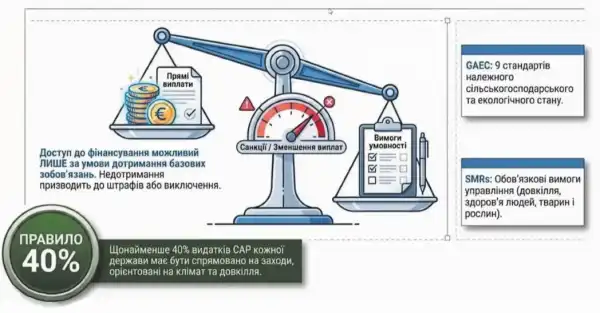
Financing rules require adherence to certain requirements Nine rules will need to be followed, and they relate to ecology. In particular, it concerns the preservation of pastures — that is, allocating a certain share of agricultural land in each region for pastures. Protection of wetlands and peatlands is also envisaged. For farmers who do not drain these areas and preserve them in their natural state, additional payments will be introduced.
Burning vegetation is also prohibited — however, such a norm already exists in Ukraine. Separate provisions are made for the protection of riparian zones and the creation of buffer zones. Other requirements include soil cultivation that reduces the risk of erosion, maintaining minimal soil cover, and crop rotation. Furthermore, the destruction or plowing of certain natural landscape elements will be prohibited. Additionally, ecologically sensitive permanent pastures will be created — meaning a portion of agricultural land will be specifically designated as needing to be preserved in its natural state as pastures and not have its use changed. A relevant draft law has already been registered in the Verkhovna Rada and is intended to enshrine these rules at the legislative level.
Such rules may cause some fear, as it seems that many new and unfamiliar practices will have to be implemented in Ukraine. Moreover, some of these requirements are difficult to understand not only for Ukrainian producers but also for European farmers themselves. That is why protests against stricter environmental requirements in agriculture are regularly held in EU countries.
The European Commission constantly tries to find a balance between two directions: on the one hand, environmental protection, and on the other, the ability for farmers to work without excessive restrictions, earn money, and support their families.
But it must be remembered that these rules are implemented so that future generations can also use these lands, on which we farm today.
In Ukraine, we also have the problem of land degradation, and these practices are aimed at preventing it. To prevent their implementation from becoming too burdensome for farmers, direct support is provided.
Often, farmers fear that they will have to maintain a complex accounting system or undergo constant audits. In reality, it involves simple daily records that may be checked later. At the same time, it is important for the farmer to know their plots and lands well. This is basic documentation that needs to be regularly maintained for future reporting.
The issue of water use without harming the environment, soil protection, biodiversity, and nitrogen management also remains relevant. I think you have also heard about the Nitrates Directive, which limits the application of nitrogen, including manure, for farmers. This is also a problematic issue for many EU member states.
In some countries, particularly in Poland, the implementation of these rules took years. In Ukraine, the discussion on this also continues. I will say right away that these norms will be introduced — the only question is how long it will take to implement them.
Regarding water use, there is a clear algorithm of actions for farmers. Conditionally speaking, you will have a checklist by which you will need to check and keep simple records to show them to an inspector who will come for an inspection.
Soil protection practices are generally not something new. These include prohibiting stubble burning, measures to prevent erosion, protection of valuable agricultural land, care for landscape elements, and adherence to mowing dates. All of this is aimed at preserving biodiversity and protecting the natural environment.
Similar requirements in one form or another already exist in Ukraine. Perhaps they are controlled less strictly or are not always a priority, but overall, these approaches are already familiar to farmers.
Regarding the Nitrates Directive, it imposes restrictions on the application of nitrogen fertilizers and manure. This is quite a complex regulation, and perhaps one of the most complex, as it outlines clear conditions for applying fertilizers and organic waste. For example, nitrogen application should not exceed 170 kg per hectare per year. It is forbidden to fertilize during certain seasons when there is a risk of floods, waterlogged soil, or when the soil is frozen. Special attention is paid to nitrogen application near water bodies. Furthermore, in the future, control over the fertilizer application calendar will be required. Periods when their application is prohibited will be established. In addition, accounting will be necessary — including recording the purchase, storage, and application of fertilizers.
A few words about biodiversity protection and conservation — aimed at supporting the environment, preserving insects, birds, especially for farmers whose plots border, say, a forest or are close to water.
Please tell us in more detail how the management, payment, and control system for agricultural support will be organized in Ukraine after the implementation of the new rules?
— To ensure all these payments and launch the relevant systems, Ukraine is already creating several new elements that did not exist before. First of all, it is a special management body — a pilot structure based at the ministry, which will coordinate the implementation of this entire policy. This body will be responsible for developing the strategic plan, evaluating results, and controlling compliance with integrity rules.
The direct execution of payments and their control will be carried out by a new structure, which does not yet exist in Ukraine. However, a law has already been adopted, and the powers of the Farmer Support Fund have been defined to perform the functions of a paying agency. This will be a quite interesting structure that will have a range of control tools at its disposal — I will explain them in more detail later.
A data collection network will also be created, as all decisions must be made based on reliable information. This refers to the FSDN (Farm Sustainability Data Network). Perhaps you have already heard of it or even encountered certain myths — for example, that all farmers will be forced to participate in FSDN and fill out relevant questionnaires. And these questionnaires, I must say, are not simple — about 60 pages long, which need to be filled out.
I want to state right away that participation in data collection is absolutely voluntary, meaning no farmer will be forced to participate if they do not wish to provide this data. It will not affect payments or any other decisions.
In Ukraine, we are currently implementing an electronic system for receiving agricultural support. Many processes are already being digitized, and we are, in fact, relying on the electronic version. You have probably heard of the State Agrarian Register — it is through this that support is currently provided. A farmer needs to register in the system and monitor information in their personal account. There, it will be visible which support programs can be applied for, and there the application can be generated and submitted. Then, the paying agency will check the application. It will look at whether everything is filled out correctly, verify the data, and only after that make a decision on payment.
I know that many encountered peak loads when we received a large number of applications. Unfortunately, certain limitations do not allow processing such a volume of simultaneously submitted applications, but, as colleagues working with digital tools assure, this problem will be resolved very quickly, and there should be no problems with submitting applications in the future.
A few words about how the paying agency will work. It will be a single body responsible for controlling all payments. It will bear full responsibility for ensuring that the system operates transparently and without abuse. The paying agency will check applications, calculate support amounts, and undergo accreditation from the European Commission and regular audits. That is, its work will be constantly monitored. I emphasize this separately because transparency of activity is a key element here. If we can make the system as open and automated as possible, show that applications are considered fairly and without corruption risks, then Ukraine will be able to fully qualify for European funding.
For this purpose, a multi-level control and audit system will also be introduced. First, there will be an internal audit of the paying agency itself — a separate independent unit will check how the system works and whether everything is done correctly. In addition, there will be an external audit. It may be conducted by state bodies or independent audit companies with appropriate reputations. That is, the work of this institution will be checked at several levels to ensure transparency and trust in the system.
And there will be a third level — European control and audit, when monitoring and auditing of this system will be carried out, and decisions on its accreditation will be made. That is, a multi-stage control mechanism to prevent any manifestations of opaque use of funds.
Within this paying agency system, a digital control system will be implemented, which in European legislation is associated with the Integrated Administration and Control System (IACS), and in the Ukrainian context, its analogue is often used — ISAK. This is a multi-level digital system that allows tracking and verifying data in an automated mode. In essence, this means that an inspector or responsible employee does not make decisions “manually” without additional tools — they work with digital data that allow checking an application, comparing information, and minimizing the risks of errors or abuses. Starting from access to regular registers, which we are currently working with, to more complex systems: land plot identification systems, territory monitoring, including from the air. Satellite monitoring will also be introduced. A farmer submits an application and confirms that they cultivate a certain land plot and grow specific products on it. Then, the inspector will have several verification tools: they can either go to the site and conduct a physical inspection and measurements, or use satellite monitoring data to verify whether the declared information corresponds to the actual situation in the field.
It is envisaged that such monitoring will be carried out by at least two independent inspectors — this is the so-called “four-eyes” principle. Each of them will independently form their conclusion regarding the application. And only if their conclusions coincide, the materials will be forwarded further — along the management hierarchy — for final approval by management.
In addition, a so-called automatic verification system will be created, called “Red Flag.” This means that if a farmer is conscientious, has had no problems with the law, adheres to all rules, they will be checked very rarely or not at all. In other words, if a farmer is conscientious, has no violations, everything works according to the rules, there are no risks, and the system has assessed them as a low-risk farm, they simply receive their support and practically do not interact with the state.
If a farmer is conscientious, has had no problems with the law, adheres to all rules, they will be checked very rarely or not at all
If there were violations in previous periods, or if the system found that the submitted data does not match information from registers, or other risks were identified, then the system automatically flags such an application as risky — figuratively, with a “red flag.” This means that such a farm requires additional attention and verification. In such cases, an inspector may assign a more detailed analysis or visit the site for further inspection.
So, Ukraine is confidently moving towards the European Union.
— Now it is important to speak clearly about the direction of our movement and the specific steps that Ukraine must take on the path to the European Union. This information must be open and understandable to farmers. This is necessary because there is a certain distrust and confusion regarding future changes. Some farmers even doubt whether it is worth going this way at all, believing that the current system works well enough.
There is a saying that the strength of a chain depends on the strength of its weakest link. Therefore, we are now working to create a unified system where there will be no weak links, which will operate in accordance with EU requirements. We will work on this system for several years, improving it. We are already testing individual programs, analyzing them, and identifying weak spots to avoid them in the future. Today, we are in the process of rapidly forming European institutions.
Yuliia Naruzhna, [email protected]